
By Katie Rea — spiritual director, writer, and companion for those listening deeply to life as it is.
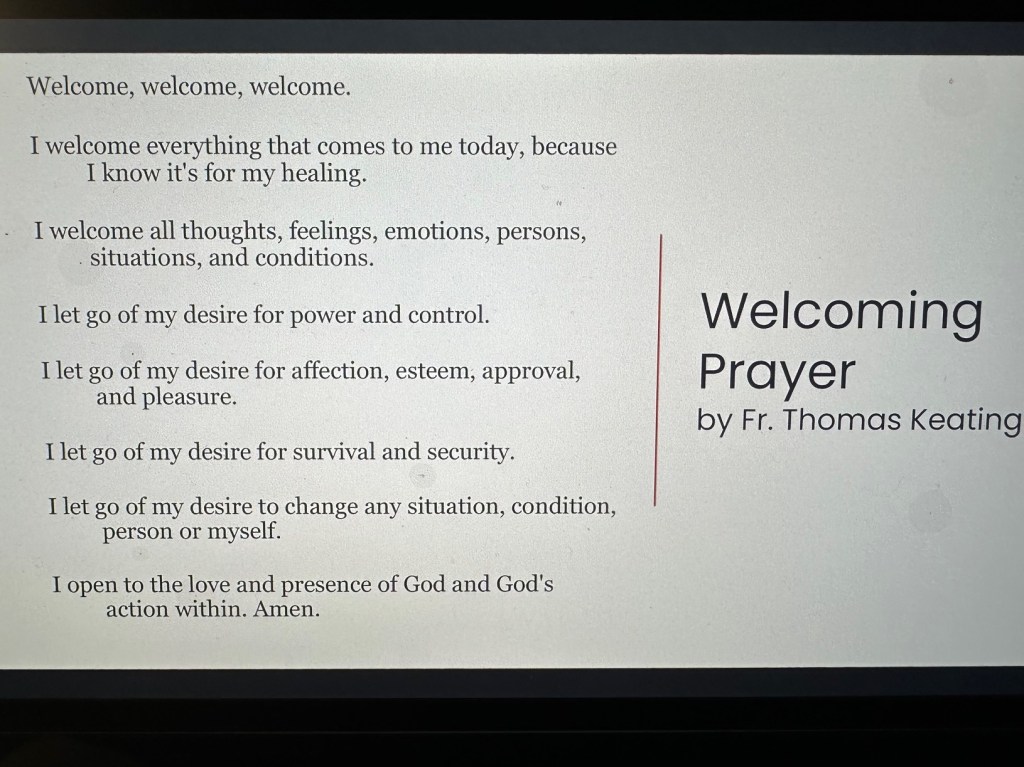
Sister Esther Wibowo opened our workshop, not with an agenda or introductions, but with Father Thomas Keating’s Welcoming Prayer:
Welcome, welcome, welcome.
I welcome everything that comes to me today because I know it’s for my healing.
I welcome all thoughts, feelings, emotions, persons, situations, and conditions.
I let go of my desire for power and control.
I let go of my desire for affection, esteem, approval, and pleasure.
I let go of my desire for survival and security.
I let go of my desire to change any situation, condition, person, or myself.
I open to the love and presence of God and God’s action within. Amen
I recently took part in a workshop led by Sister Esther, titled “Spiritual Directors on Practical Questions: What’s My First Next Step?” Speaking from the quiet beauty of the Transfiguration Hermitage Monastery in Windsor, Maine, Sister Esther offered her insights in collaboration with St. John’s School of Theology and Seminary.
The workshop was an opportunity for us to open up about our imperfections and to enter a safe space to discuss how we can take our next step to self-improvement.
At the end of the workshop, during the Q&A with Sister Esther Wibowo, an attendee opined, “There is a paradox in the Welcoming Prayer, which suggests that we let go of the desire to change ourselves, and the idea of taking steps to let go of difficult patterns. I wonder if you can say a bit about that.” She went on to say she had always had trouble with the Welcoming Prayer. “How can we change ourselves, if we are to accept what is?”
The sister seemed initially perplexed by the question. I don’t blame her. I was too. It hadn’t occurred to me to explore such a paradox in The Welcoming Prayer.
The prayer is rooted in the teachings of Fr. Thomas Keating and the prayer invites us to “let go of the desire for security, affection, control, and to embrace the present moment as it is.” And yet, many who pray it, like within this workshop, are also seeking healing, transformation, or release from painful patterns.
So how do we hold both? By surrender? Or transformation? Which is it?
I would say, both.
Letting go of the desire to change doesn’t mean resignation or passivity. It means releasing the ego’s grasp of us that wants to fix, manage, or perfect ourselves to earn acceptance, love, or safety.
Welcoming what is, even our resistance, our shame, our compulsions, is a radical act of trust. It says, “God is here, even in this.”
“God is here, even in this.”
God is here even amidst my procrastination. My perfectionism. My self-righteousness.
The divine presence itself begins to soften and transform us, oftentimes more slowly than we would like.
We should not view the Welcoming Prayer as a technique to change ourselves. It’s a posture of consent to the Divine. In consenting to the presence of God in our pain, we allow grace to do what our personal striving cannot.
For example, instead of saying, “I must change,” the prayer invites, “I welcome what is, and trust that Love is already at work.” We allow God to help us transform into a better version of ourselves.
Perhaps more loving.
More patient.
More content.
This paradox allows us to embrace our humanity, to appreciate the journey we’ve taken, and to be thankful for the road God has planned ahead.
A newsletter by Katie Rea.


Leave a reply to Katie Rea Cancel reply